

Table of Contents
- Step 1: Assess the Damage and Decide: Repair, Reuse, or Remove
- Step 2: Break Down Large Broken Furniture Safely
- Step 3: Compare Your Disposal Options
- Step 4: Schedule a Furniture Removal Service or Same Day Junk Removal
- Step 5: Arrange Old Furniture Haul Away for Oversized Items
- Common Mistakes to Avoid When Disposing of Large Broken Furniture
- Conclusion
- Frequently Asked Questions
Last Updated: September 16, 2026
Step 1: Assess the Damage and Decide: Repair, Reuse, or Remove
The first move with large broken furniture is deciding whether it can be repaired. A wobbly leg or cracked joint is often fixable with wood glue and a clamp; a snapped frame or water-swollen particleboard usually is not.
When Large Broken Furniture Can Be Repaired or Repurposed
Repair makes sense when damage is cosmetic or isolated: a broken drawer slide, a loose chair rung, a wobbly table leg. Repurposing is next, a broken dresser becomes garage shelving, a headboard becomes a garden trellis. But if a replacement part costs more than the piece is worth to you, removal is the practical call.
How to Separate Materials Before Disposal
Disassembly by material determines where each part ends up. Upholstered furniture typically contains wood, metal springs, foam, and fabric, each going to a different place.
- Wood: clean, untreated lumber can go to wood recycling or a transfer station
- Metal: springs, brackets, and frames are scrap metal, often accepted at recycling facilities
- Foam and fabric: usually landfill-bound unless a textile recycling program exists locally
- Glass and mirrors: separate carefully; many curbside programs reject them
Step 2: Break Down Large Broken Furniture Safely
Breaking down large broken furniture safely means reducing it to manageable pieces before anyone lifts it. A sofa cut into frame sections, cushions, and fabric is three safer loads, and separated material streams each have a better chance of being recycled instead of landfilled.
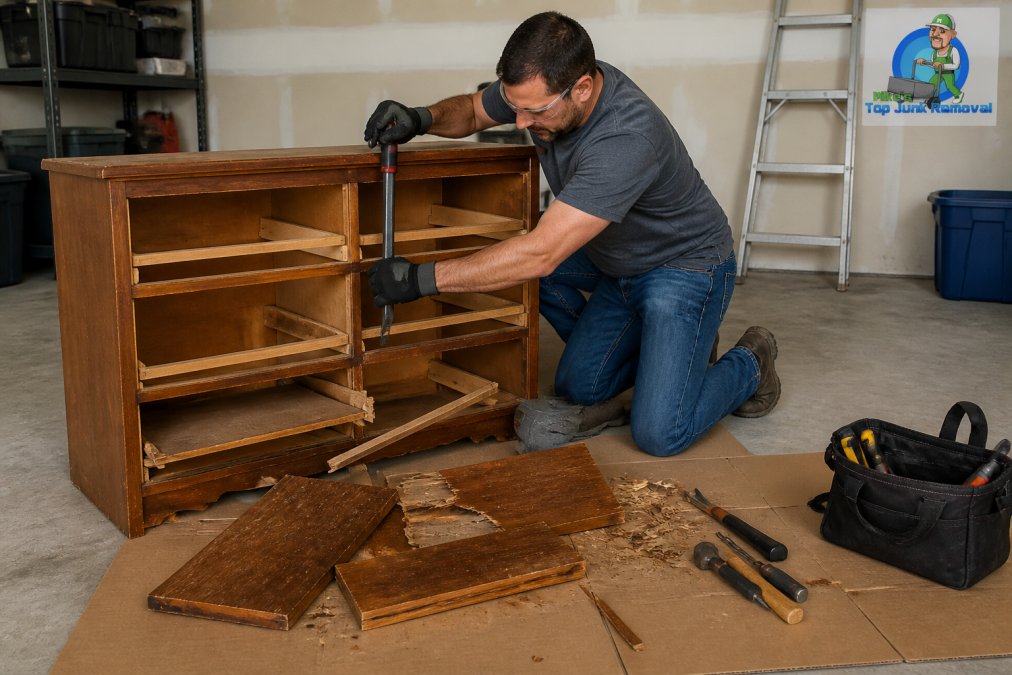
Tools and Safety Gear You Need
Gather these before you start:
- Work gloves and safety glasses
- A pry bar or flat-head screwdriver
- A cordless drill or screwdriver for fasteners
- A utility knife for fabric and foam
- A hammer
- Cardboard or a tarp to protect the floor
- A magnet to test whether metal parts are ferrous
- A respirator or N95 mask if you are cutting into older upholstery or painted wood
The magnet tells you instantly whether a bracket is scrap metal worth separating or a coated alloy headed for the trash. The respirator matters because cutting into older furniture can release dust, foam particles, and, in pre-1978 pieces, lead paint dust.
Step-by-Step: Dismantling a Sofa, Dresser, or Bed Frame
- Clear the work area and lay down cardboard.
- Remove cushions, drawers, and any loose hardware first.
- Flip the piece and remove visible screws, bolts, and staples.
- Use the pry bar on joints that resist; work slowly to avoid splintering.
- Cut upholstery along seams with the utility knife and pull foam free.
- Separate wood, metal, foam, and fabric into distinct piles.
- Bag small hardware so it does not scatter.
For a bed frame, remove the headboard and footboard bolts before the rails. For a dresser, pull the drawers and detach the thin back panel. For a sofa, the frame is often stapled rather than screwed, so a pry bar and hammer work better than a drill.
How to Separate Materials for Recycling vs. Landfill
This step determines where each part ends up.
- Wood: clean, untreated lumber can go to wood recycling or a transfer station. Painted, stained, or composite wood (particleboard, MDF) is usually landfill-bound.
- Metal: springs, brackets, and frames are scrap metal, often accepted at recycling facilities. Use your magnet to confirm ferrous metal.
- Foam and fabric: usually landfill-bound unless a textile recycling program exists locally. Some municipalities accept clean foam at special collection events.
- Glass and mirrors: separate carefully; many curbside programs reject them. Wrap in cardboard and tape before disposal.
It also matters at the gate: a transfer station that sees a sorted metal pile will accept it, while a whole sofa often gets rejected or redirected to the landfill.
Identifying Hazardous Materials in Older Furniture
Older furniture can contain materials requiring special handling. Before you cut into a piece, consider its age:
- Pre-1978 painted wood may contain lead paint. Cutting or sanding releases lead dust. If the piece is painted and old, avoid power tools and wear a respirator.
- Older upholstered furniture may contain flame retardants in the foam. These are not recyclable and should not be burned. Bag foam separately and send it to the landfill rather than a recycling stream.
- Pressed wood and particleboard often contain formaldehyde-based binders. Cutting them releases dust; work outdoors or in a ventilated space.
- Mirrors and glass are not recyclable in most curbside programs and should be wrapped and disposed of separately.
Step 3: Compare Your Disposal Options
Disposal options for large broken furniture fall into four buckets: bulk trash pickup, recycling facility or transfer station drop-off, a furniture removal service, and old furniture haul away for oversized pieces.

| Option | Effort | Best For | Watch Out For |
|---|---|---|---|
| Bulk trash pickup | Low | Single items on a set schedule | Size limits, collection schedule rules, upholstery exclusions |
| Recycling facility / transfer station | High | Sorted metal and clean wood | Permit requirements, drop-off site hours, load limits |
| Furniture removal service | None | Multiple items, tight timelines | Confirm disposal method upfront |
| Old furniture haul away | None | Oversized or heavy pieces | Access and stairwell constraints |
Bulk Trash Pickup and Curbside Collection Rules
Bulk trash pickup is the lowest-effort route when it works, but municipal regulations vary widely by zip code. Many solid waste departments cap oversized items per collection, require them at the curb by a set time, and exclude upholstered furniture entirely. Some cities require you to schedule a bulky item pickup in advance.
How to Find Your Specific Municipal Rules
Regulations vary wildly by zip code, so go straight to the source rather than a generic guide:
- Start with your city's 3-1-1 line or online service portal. Most municipal waste departments route bulky item questions through 3-1-1 and let you schedule a pickup online.
- Search your city or county waste management page directly. Look for "bulky item pickup," "large item disposal," or "special collection" pages listing size limits, accepted materials, and scheduling windows.
- Check your hauler's rules if you live in a private-collection area. Many areas contract trash service through a private hauler that sets its own bulky item rules.
- Call the transfer station or recycling facility before you load. Ask about permit requirements, whether they accept upholstered items, and load size limits.
- Confirm the day-of rules. Some jurisdictions require items at the curb by 6 a.m.; others give a multi-day window.
Recycling Facility and Transfer Station Drop-Offs
A recycling facility or transfer station accepts sorted material, not assembled furniture. Call ahead about permit requirements and whether they take upholstered items. Scrap metal is easiest to place: stripped frames and springs are often accepted without question because they have clear resale value.
Step 4: Schedule a Furniture Removal Service or Same Day Junk Removal
A furniture removal service handles the entire job: disassembly, lifting, loading, and disposal. This is the right call when the piece is too heavy to move, when you have several items, or when you need it gone today.
What Same Day Junk Removal Looks Like
A crew arrives, confirms the items, and gives you a firm price before any work starts, then carries everything out, loads it, and hauls it away. You do not touch a pry bar.
Step 5: Arrange Old Furniture Haul Away for Oversized Items
Old furniture haul away is the category for pieces no standard pickup will touch: sectionals, sleeper sofas, pianos, and oversized entertainment centers. These items are heavy, awkward, and often too large for one person to move safely.
Before booking haul away, answer:
- How many flights of stairs are involved?
- Will the piece fit through doorways, or does it need disassembly first?
- Is there elevator access?
- Are there narrow turns that require the piece to come apart?
Common Mistakes to Avoid When Disposing of Large Broken Furniture
The most common mistake is leaving furniture at the curb without checking local rules, a rejected item is your problem again by evening, and illegal dumping fines exist for a reason.
Conclusion
Getting rid of large broken furniture is manageable once you decide between repair, reuse, and removal, then match the piece to the right disposal channel. The work is in the assessment and sorting, not the hauling.
Frequently Asked Questions
What is the safest way to break down large broken furniture for disposal?
Start by clearing the area and putting on work gloves, safety glasses, and closed-toe shoes. Remove cushions, drawers, and hardware first, then use a pry bar or screwdriver to separate joints rather than sawing through them. For upholstered pieces, cut fabric away from the frame with a utility knife and pull out staples with pliers. Bag loose foam and stuffing separately so they do not blow away. If the frame is unstable or contains glass, stop and call a furniture removal service instead of risking injury.
Can I leave broken furniture on the curb for regular trash pickup?
Most municipal waste departments will not take large broken furniture as part of regular curbside collection. You usually need to schedule a bulky waste pickup or bring items to a transfer station. Rules vary by city, so check with your solid waste department for size limits, permitted items, and collection schedules. Items left on the curb without a scheduled pickup can be tagged as illegal dumping, which may result in a fine. When in doubt, arrange a bulk trash pickup or hire a hauler.
How do I prepare large broken furniture for professional removal?
You do not need to break anything down for a professional furniture removal service. Clear a path to the item, remove personal belongings from drawers or cushions, and let the crew know about any glass, exposed nails, or fragile parts. Most companies handle the lifting, loading, and disposal. If you have multiple items like appliances, mattresses, or debris, mention them when you book so the team arrives with the right truck and crew size for a single trip.
What are the benefits of hiring professional junk removal for large items?
Professional junk removal saves you the physical strain of moving heavy furniture, the risk of injury from broken frames or glass, and the hassle of figuring out where each material goes. A reputable hauler separates recyclable materials like scrap metal and wood from landfill-bound waste, which supports landfill diversion. They also handle the paperwork and logistics of drop-off sites. For homeowners with multiple items or tight schedules, same day junk removal offers a convenient solution.