

Table of Contents
- What You'll Need Before You Start
- Step 1: Map Your Waste Stream and Check City Code
- Step 2: Set Up Bulk Trash Pickup and Bulky Item Removal
- Step 3: Add Composting and Waste Diversion for High-Density Housing
- Step 4: Bring In Commercial Junk Removal for Large-Scale Cleanouts
- Step 5: Use Property Cleanout Services for Turnovers
- Common Mistakes to Avoid in Multi-Family Housing
- Conclusion
- Frequently Asked Questions
Last Updated: October 2, 2026
What You'll Need Before You Start
Eco-friendly waste disposal for Tampa multi-family housing starts with a simple shift: treat your dumpsters as a managed system, not an afterthought. This guide from Mike's Top Junk Removal walks property managers through five steps, from mapping your waste stream to clearing abandoned units. Most of it costs nothing but planning.

Before you begin, gather these basics:
- A copy of your city's solid waste ordinance and recycling rules
- Your current hauler contract and pickup schedule
- A list of common areas, compactor locations, and bulk item zones
- Contact info for a licensed junk removal company
- A budget line for green initiatives, even a small one
Step 1: Map Your Waste Stream and Check City Code
Start by counting what actually leaves your property each week. Walk every trash room, chute room, compactor pad, and bulk zone, and record bin sizes, pickup days, and overflow spots on a simple spreadsheet. Do this for two weeks, including one weekend, because weekend volume tells a different story than weekday volume.
Build a Simple Waste Stream Map
A waste stream map is just a table with four columns: location, stream type, container size, and pickup frequency. Fill it in for every collection point on the property.
Then split your waste into four streams, not three:
- Household trash going to a sanitary landfill or waste-to-energy facility.
- Recyclables like cardboard, glass, aluminum, and mixed paper.
- Bulk-waste items such as mattresses, appliances, furniture, and electronics.
- Organic waste such as food scraps and landscaping trimmings, which is the stream most properties never measure.
Know How Multi-Family Recycling Rules Differ
Every city sets its own recycling ordinance, and multi-family properties often fall under different rules than single-family homes. That threshold usually starts at two or more dwelling units, which is why duplexes and small walk-ups are not exempt.
- Whether the city requires recycling access for tenants, and what counts as adequate access (a bin in the trash room, a separate recycling room, or curbside service).
- How the ordinance defines recycling contamination, and whether contaminated loads can be rejected or surcharged.
- Whether the property owner or the hauler is responsible for providing and labeling containers.
- What fines or compliance notices apply for repeated violations, and how many notices precede a fine.
- Whether there is a separate commercial or multi-family collection requirement that differs from residential service.
Document Compliance From Day One
Keep a compliance file with the ordinance excerpt, your hauler contract, pickup schedules, and any notices you receive. If a violation notice arrives, you want a dated record showing when you corrected it. Property managers who can show a correction timeline resolve notices faster than managers who have to reconstruct events after the fact.
Step 2: Set Up Bulk Trash Pickup and Bulky Item Removal
Bulk trash pickup handles the big stuff that won't fit in a cart. Most cities run scheduled bulk collection, but the rules vary by address and item type.
Here's what to confirm with your city or hauler:
- Which items qualify as bulk waste
- How far ahead you must schedule pickup
- Where items can legally sit before collection day
- What gets rejected, like tires or construction debris
Step 3: Add Composting and Waste Diversion for High-Density Housing
Composting in a high-rise looks nothing like a backyard bin. In a 200-unit building, food scraps are heavy, wet, and generate odor fast, so the program has to be designed around collection logistics, not enthusiasm.
Pick the Right Composting Model for Your Building
There are three workable models for multi-family housing, and the right one depends on unit count, grounds crew capacity, and whether a hauler in your area accepts food scraps.
- Centralized collection with a hauling partner. You place sealed 32- or 64-gallon carts in a dedicated waste room, and a commercial hauler picks them up on a set schedule. This is the most scalable option for towers because it requires no on-site processing. Confirm the hauler accepts post-consumer food scraps, not just yard waste, and ask whether they require compostable liners.
- On-site tumblers or aerated static piles for grounds crews. This works for garden-style communities with landscaped common areas. Your maintenance team composts landscaping trimmings and a limited amount of pre-consumer food waste from the leasing office. It does not scale to resident food scraps in a high-rise because of volume and pest pressure.
- In-unit or floor-level drop points. Small countertop collectors that residents empty into a floor-level bin reduce the walk distance, which is the single biggest predictor of participation. This model needs daily or every-other-day servicing to control odor.
Design the Program So Residents Actually Use It
Waste diversion works when it is easier than throwing everything in the trash. A few design rules make the difference:
- Place compost collection in the same room as the trash chute or compactor, never in a separate location. If residents have to make a second trip, participation drops.
- Use color-coded, lidded bins with clear liners so residents and staff can see contamination at a glance.
- Post signs at eye level with pictures of what goes in, not just words. Visual signage outperforms text-only signage for contamination control.
- Start with one building or one floor, measure participation, then expand. Rolling out building-wide on day one usually produces a contaminated first load.
- Weigh or estimate tonnage monthly so you can show owners the diversion rate and defend the program at budget time.
The Resident Guide Template Most Managers Skip
This is the angle most property managers miss, and it is the cheapest lever you have. Recycling contamination is rarely a resident attitude problem; it is an information problem. A one-page resident guide handed over at move-in, plus a quarterly reminder posted in the elevator and emailed through the resident portal, does more for your diversion rate than any new bin.
Commercial Cleanouts & B2B Services →
- What goes in each stream (trash, recycling, compost, bulk) with pictures.
- Where each bin lives on the property, floor by floor if needed.
- What never goes in a chute or cart (mattresses, appliances, electronics, liquids, bagged pet waste in recycling).
- How to schedule a bulk item pickup or request a cleanout.
- Who to contact with a question, with a name and a direct channel, not a generic inbox.
Connect Diversion to Operating Costs
Sustainable practices also lower long-term costs, but the mechanism matters. Less trash volume often means fewer pickups or a smaller dumpster size at contract renewal, and fewer pickups mean a smaller hauling bill. Compactor pulls get less frequent when cardboard is diverted out of the trash stream. Track your tonnage and pull frequency for two quarters before you renegotiate, so you have data instead of a pitch.
Step 4: Bring In Commercial Junk Removal for Large-Scale Cleanouts
Some jobs are too big for a dumpster. That's when commercial junk removal makes sense.

Use it for:
- Warehouse and storage room cleanouts
- Construction debris removal after renovations
- Bulk furniture and equipment removal
- Foreclosure cleanout and hoarder cleanup situations
Step 5: Use Property Cleanout Services for Turnovers
Fast turnovers decide your vacancy loss. Property cleanout services clear a unit in one visit so your crew can paint, repair, and re-list without waiting.
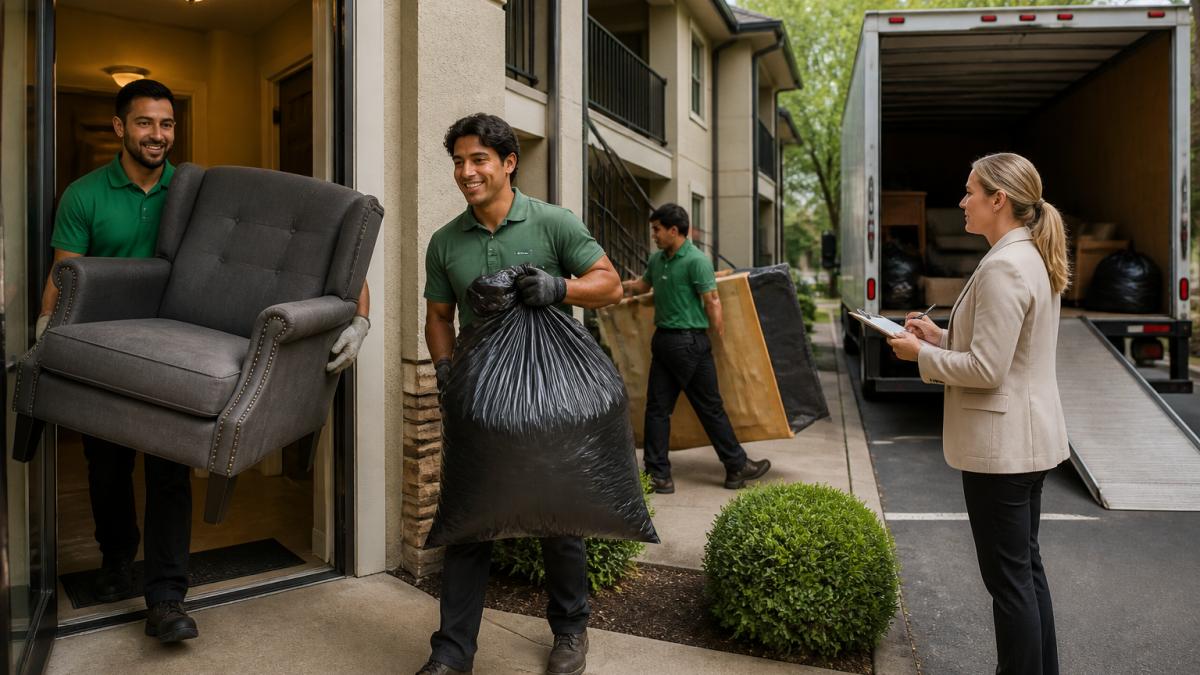
Good cleanout partners handle the whole job:
- Remove abandoned furniture, appliances, and personal items
- Haul everything in one trip when possible
- Dispose responsibly, with recycling where it's available
- Work around your leasing schedule
| Situation | Best Option | Who Handles It |
|---|---|---|
| Weekly household trash | City or hauler pickup | Property manager |
| Mattresses, appliances | Bulk trash pickup | City program |
| Food scraps, yard waste | Composting program | Manager plus tenants |
| Renovation debris | Commercial junk removal | Licensed hauler |
| Abandoned unit contents | Property cleanout services | Licensed hauler |
Common Mistakes to Avoid in Multi-Family Housing
Other missteps that cost managers time and money:
- Ignoring compactor maintenance until it breaks during a holiday week
- Letting recycling contamination build until the hauler rejects the load
- Skipping collection scheduling updates when occupancy changes
- Waiting until move-out day to book a cleanout
- Assuming tenants already know the litter rules
Smart waste technology is the next step for larger communities. Fill-level sensors and route software can cut overflow calls, though the payback depends on unit count and pickup frequency.
Conclusion
Running an eco-friendly waste program across multiple buildings takes planning, but the payoff shows up in lower fines, cleaner grounds, and happier tenants.
Frequently Asked Questions
What are the requirements for multi-family recycling programs?
Multi-family properties generally must provide recycling collection that is as convenient as trash service, with clearly labeled containers in common areas or at each building. Many cities require property owners to distribute written recycling information to residents at move-in and at least once a year. Check your local recycling ordinance for container labeling, contamination limits, and reporting obligations, since non-compliance can trigger fines. Pair your recycling setup with scheduled bulk trash pickup so bulky-waste items do not end up in recycling bins and contaminate the stream.
How can property managers reduce waste in apartment complexes?
Start by auditing what actually leaves your dumpsters each week. Then add three things: labeled recycling and composting stations, a tenant-facing guide explaining litter rules and disposal guidelines, and a scheduled bulk item removal day each month. These steps cut contamination and overflow, which are the two biggest drivers of extra collection costs. Property cleanout services also help during turnovers, when abandoned furniture and appliances would otherwise sit at the curb and hurt curb appeal.
What is the best way to handle bulky item disposal for residents?
Give residents one clear channel instead of letting them leave sofas and mattresses in hallways. Many cities run scheduled bulky item removal by appointment, and a hauling partner can handle overflow between those dates. Publish the rules in your tenant guide, post signage at each trash enclosure, and set a monthly pickup window. This keeps bulk-waste items out of compactors, where they cause jams and expensive compactor maintenance.
How do professional junk removal services support sustainability?
A good hauler sorts what it collects. Usable furniture, appliances, and metal go to recycling or reuse channels rather than straight to a sanitary landfill. Mike's Top Junk Removal, for example, offers eco-friendly disposal and recycling as part of its residential junk removal service, and its commercial cleanout service covers construction debris and bulk equipment. That means fewer tons landfilled and less incineration, which supports your property's waste diversion goals.