

Table of Contents
- Why Garage Clutter Happens and How to Start Fresh
- Step 1: Sort Items Into Keep, Donate, and Toss Categories
- Step 2: Create a Staging Area and Clear Floor Space
- Step 3: Arrange Storage Solutions and Maximize Vertical Space
- Professional Garage Cleanout Service Options
- Same Day Junk Removal for Immediate Cleanup
- Appliance Removal Near Me and Heavy Hauling Services
- Common Mistakes to Avoid During Garage Decluttering
Last Updated: August 30, 2026
Why Garage Clutter Happens and How to Start Fresh
Garages transform into storage black holes faster than most homeowners realize. Tools get buried, seasonal items stack up, broken appliances linger, and before long, you can't park your car inside. The problem isn't laziness, it's that garages become the default dumping ground for everything that doesn't fit elsewhere in the home.
The good news: clearing garage clutter is entirely manageable when you approach it systematically. At Mike's Top Junk Removal, we've helped homeowners reclaim their spaces by breaking the process into clear, actionable steps. The difference between a successful garage cleanout and a failed attempt usually comes down to having a solid plan before you start moving things around.
Most people fail at garage organization because they try to organize before they declutter. That's backwards. You need to sort first, decide what stays and what goes, then arrange what remains. This guide walks you through exactly how to clear garage clutter efficiently, from the initial sorting phase through the final disposal of items you no longer need.
The National Association of Professional Organizers emphasizes that successful decluttering requires a systematic approach to sorting and decision-making. Let's break down the proven method that works.
Step 1: Sort Items Into Keep, Donate, and Toss Categories
The foundation of any successful garage cleanout is the sorting process. Before you move a single item or arrange any storage, you need to make clear decisions about what deserves space in your home and what doesn't.
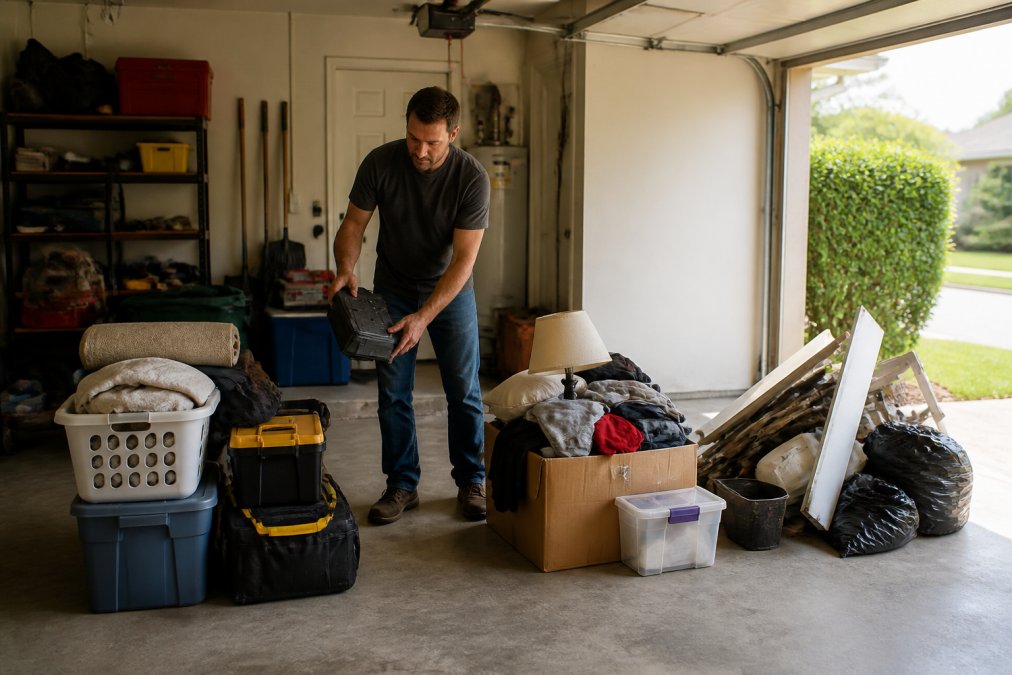
The Keep-Toss-Donate Method
The keep-toss-donate framework is the most effective sorting system because it forces binary decisions. You're not creating a "maybe" pile, every item gets one of three destinations.
Start by removing everything from shelves, corners, and storage areas. Yes, everything. This seems extreme, but it's essential. When items stay partially hidden, you never actually evaluate whether you need them. Pull everything into the center of your garage where you can see it clearly.
As you handle each item, ask three specific questions: Do I use this regularly? Would I buy this again today? Does it work properly? If you answer no to all three, it doesn't belong in your keep pile.
Items with sentimental value deserve special consideration. Nostalgia is real, but a garage isn't a museum. Keep the things that genuinely matter, the tools you use, the equipment that functions, the seasonal items you rotate through annually. Everything else takes up space that could serve you better.
The keep pile should contain tools you actively use, working equipment, seasonal decorations you rotate annually, and items with genuine functional or sentimental value. Be honest about what actually gets used versus what's been sitting untouched for three years.
The donate pile includes items in good working condition that you no longer need. Bicycles gathering dust, exercise equipment you never use, kitchen gadgets that seemed essential but never made it out of the box, these items can find homes with people who will actually use them.
The toss pile is for broken items, damaged goods, anything with missing parts, and things too worn out to donate. Broken lawnmowers, cracked storage bins, furniture with structural damage, these go to the landfill or appropriate disposal facility.
Handling Hazardous Materials Safely
Garages often contain materials that require special disposal. Paint cans, motor oil, batteries, propane tanks, and chemical cleaners can't simply be thrown in a regular trash pile.
Check your local waste management guidelines for hazardous waste collection days. Many communities offer disposal events specifically for these materials. Never pour chemicals down drains or leave them exposed. Sealed containers should be stacked safely away from living areas until disposal day arrives.
Paint cans with dried paint can sometimes go in regular trash, but liquid paint requires hazardous waste disposal. Motor oil should be collected in a sealed container and taken to a recycling center or auto parts store, many accept it free of charge. Batteries, both alkaline and rechargeable, have specific recycling programs in most areas.
If you're unsure about a particular item, contact your local environmental agency or waste management facility. They can tell you exactly how to handle it safely.
Step 2: Create a Staging Area and Clear Floor Space
Once you've sorted items into categories, you need a system for actually removing what's leaving your garage. A staging area keeps everything organized and makes the removal process efficient.
Designate a specific section of your garage for items heading out. Group your donate pile in one spot, your toss pile in another, and anything going to hazardous waste disposal in a third location. This prevents items from scattering back across the floor and makes it easy to load everything when removal day arrives.
Clearing floor space is where the real transformation happens. You'll be amazed at how much larger your garage feels once the concrete is visible. This is also when you discover what you're actually working with, the dimensions of your space, any problem areas like water stains or uneven flooring, and the actual square footage available for storage.
As you clear the floor, sweep out debris, cobwebs, and dust. Garages accumulate grime over time, and a clean floor is the foundation for organizing what remains. If you find spills or stains, address them now before you add organized storage systems on top.
A cleared floor also gives you the freedom to arrange storage solutions in the most logical way. You can walk the space, measure distances, and plan where shelving, pegboards, and storage bins will go.
Step 3: Arrange Storage Solutions and Maximize Vertical Space
The biggest mistake homeowners make is treating garage storage as a horizontal problem. They stack boxes on the floor, pile items in corners, and wonder why the space still feels cramped.
The solution is vertical storage. Most garages have 8-10 feet of wall height that goes completely unused. Shelving, pegboards, and overhead racks transform wasted vertical space into functional storage.
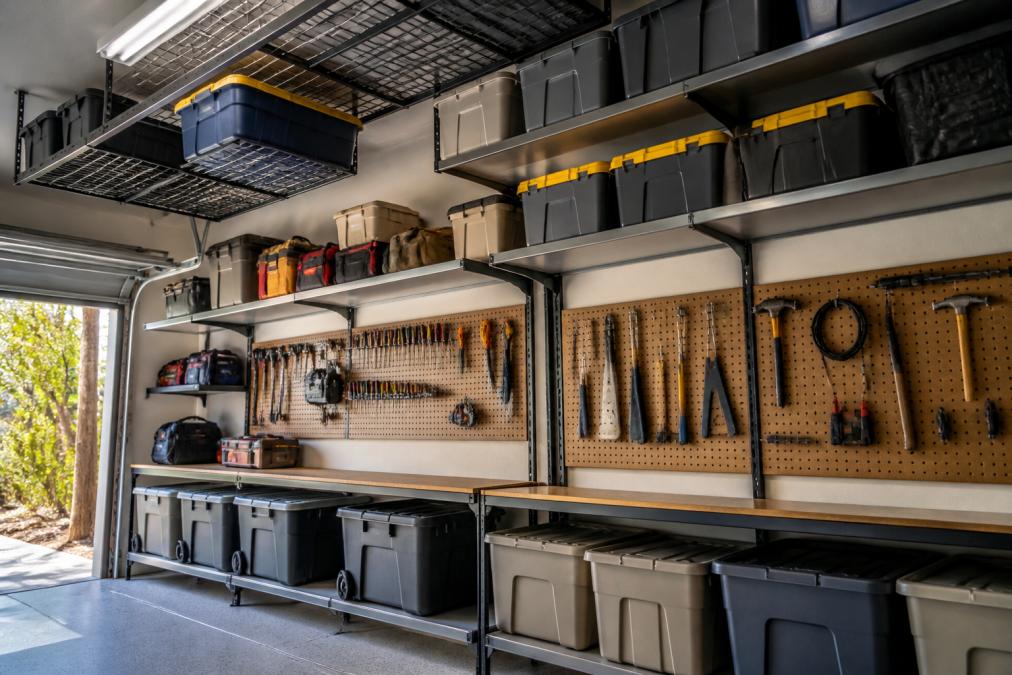
Heavy-Duty Shelving and Wall-Mounted Systems
Heavy-duty metal shelving is the workhorse of garage organization. These units hold substantial weight and last for years. A typical 4-shelf unit can hold 50+ pounds per shelf, giving you serious storage capacity.
Mount shelving units on the walls rather than freestanding in the middle of the floor. Wall-mounted shelving preserves floor space for parking, movement, and future projects. Install shelves at varying heights to accommodate different item sizes, taller shelves for storage bins, lower shelves for frequently accessed tools.
Pegboards are excellent for tools and frequently used items. They're visible, accessible, and take up minimal space. A single 4-foot pegboard can organize dozens of hand tools, cords, and small equipment. The visual organization also makes it immediately clear what you have and where it is.
Overhead storage racks are perfect for seasonal items, holiday decorations, and things you need only occasionally. These racks mount to the ceiling and keep bulky items out of the way while remaining accessible when needed. Just ensure you can safely reach items without a ladder, or install them where you're comfortable climbing to retrieve things.
Storage Bins and Labeling Systems
Clear plastic storage bins are invaluable for garage organization. You can see what's inside without opening them, they stack efficiently, and they protect items from dust and moisture.
Label every bin clearly. Use a label maker or permanent marker to write what's inside. Don't rely on memory, months later you won't remember which bin holds holiday lights and which holds camping gear. Include the date on seasonal bins so you know how long you've been storing something.
Group similar items together. All holiday decorations in one section, all seasonal clothing in another, all camping and outdoor recreation gear in a third. This makes finding things simple and prevents duplicates.
The labeling system also serves a psychological purpose. When items are organized and labeled, you're more likely to maintain the system. You'll know immediately where something belongs, and you're less likely to just toss things randomly into corners.
Professional Garage Cleanout Service Options
Some garages have accumulated so much clutter that a DIY approach becomes overwhelming. Years of buildup, heavy items you can't safely move alone, or simply not having time to tackle it yourself, these are all valid reasons to hire professional help.
Mike's Top Junk Removal specializes in garage cleanouts and can handle everything from hauling away items you no longer need. Our team removes the physical burden from your shoulders, allowing you to reclaim your space without spending weeks on the project yourself.

Professional cleanout services are particularly valuable when you're dealing with large quantities of items, heavy appliances, or hazardous materials. We handle the loading, and responsible disposal, ensuring items are recycled or donated appropriately rather than simply sent to a landfill.
Same Day Junk Removal for Immediate Cleanup
When you need to clear garage clutter quickly, same-day junk removal eliminates the waiting period. You schedule the service, we arrive and remove everything in your toss and donate piles, and your garage is cleared the same day.
This approach works exceptionally well if you've already done the sorting work yourself. Once items are categorized and staged, our team can load and haul everything efficiently. Same-day service means you see results immediately rather than living with piles of items waiting for removal.
Mike's Top Junk Removal offers same-day and next-day availability, so you don't have to wait weeks for an appointment. We provide free estimates upfront, so you know exactly what to expect before we begin.
Appliance Removal Near Me and Heavy Hauling Services
Appliances present unique challenges during garage cleanouts. Old refrigerators, freezers, washers, dryers, and other large equipment are heavy, awkward to move, and require proper disposal due to refrigerants and other materials.
Professional appliance removal near you ensures these items are handled safely and disposed of responsibly. Attempting to move a refrigerator alone can result in injury or damage to your home. Professional teams have the equipment and training to remove large appliances without incident.
Disposing of Large Items Responsibly
Heavy hauling services handle items that are too large or heavy for standard junk removal. This includes furniture, exercise equipment, storage units, and other bulky items that require specialized equipment to move safely.
Responsible disposal means items are recycled when possible, donated if they're still functional, or properly sent to appropriate facilities. Dumping items illegally creates environmental hazards and legal liability. Professional services handle this correctly.
Mike's Top Junk Removal provides eco-friendly disposal and recycling options, ensuring your items don't end up in landfills unnecessarily. We partner with recycling centers and donation facilities to give your items a second life when possible.
Common Mistakes to Avoid During Garage Decluttering
Understanding what doesn't work helps you avoid wasting time and effort.
The biggest mistake is organizing before decluttering. Buying storage bins, shelving, and organizational systems before you've removed unnecessary items means you're organizing clutter. Sort first, then organize what remains.
Another common error is keeping "just in case" items. That broken power tool you might fix someday, the extra paint from a project long finished, the furniture you're saving for a garage sale that never happens, these items take up valuable space for hypothetical future use. Keep what you actually use.
Underestimating the time required is another frequent mistake. Garage cleanouts take longer than expected, especially if you're doing it alone. Budget more time than you think you'll need, or hire professional help to accelerate the process.
Failing to address hazardous materials properly creates safety and legal issues. Don't ignore paint cans, motor oil, batteries, and chemicals. Handle them correctly from the start.
Finally, don't create a new "maybe" pile that just sits in your garage indefinitely. Make decisions during the sorting process. If something isn't clearly a keep, donate it or toss it. Indecision leads to items lingering for months.
Clearing garage clutter transforms more than just your space, it changes how you feel about your home. A functional, organized garage means you can actually park your car, find tools when you need them, and enjoy a space that works for you rather than against you. Mike's Top Junk Removal makes this transformation simple with professional removal services that handle the heavy lifting. Our residential junk removal service includes garage cleanouts with same-day availability and transparent, upfront pricing. Get your free estimate today and reclaim your space.
Frequently Asked Questions
Q: What is the best way to clear out a cluttered garage?
A: The best approach combines sorting, staging, and professional removal. Start by categorizing items into keep, donate, and toss piles. Create a staging area to work systematically through your garage. For large items like old appliances or broken furniture, professional junk removal services handle the heavy lifting efficiently. This method prevents overwhelm and ensures responsible disposal of hazardous materials.
Q: What items should you prioritize removing from a garage first?
A: Begin with hazardous materials like paint cans, batteries, and chemicals, these require proper disposal. Next, tackle broken appliances and furniture taking up floor space. Remove items you haven't used in over a year. Prioritizing these clears significant space quickly and makes the remaining organization work manageable.
Q: How do you handle hazardous waste during a garage cleanout?
A: Never mix hazardous materials with regular trash. Separate items like paint, oil, batteries, and cleaning products into a designated area. Contact your local waste management facility for disposal guidelines. Many communities offer hazardous waste collection events. Professional junk removal services know proper handling protocols and can dispose of these materials safely and legally.
Q: How can I keep my garage organized after clearing the clutter?
A: Implement a labeling system for all storage bins and shelves. Schedule seasonal maintenance to prevent re-accumulation. Use vertical space with pegboards and wall-mounted systems. Establish a rule: one item in means one item out. Regular inventory checks help you stay accountable. Most homeowners find that maintaining organization takes just 15 minutes monthly once the initial clearing is complete.
This article was written using GrandRanker