

Table of Contents
- Assess the Full Scope of Your Home Cleanout
- Create a Sorting Strategy: Keep, Donate, Sell, Discard
- Decide: Dumpster Rental vs. Full-Service Junk Removal Services
- Prepare Your Home and Gather Essential Safety Gear
- What to Expect When Your Whole House Cleanout Crew Arrives
- Plan for Estate Cleanout Services: Donations, Hazardous Waste, and Taxes
- Schedule Your Home Cleanout and Finalize Logistics
- Conclusion
- Frequently Asked Questions
Last Updated: September 9, 2026
Preparing for a home cleanout service starts with a clear plan for sorting your belongings, managing logistics, and understanding what happens to your items after they leave your driveway. Homeowners who prepare properly enjoy a faster, less stressful experience and avoid common pitfalls like misplaced documents or unexpected fees.
This guide walks you through the entire process, from the initial walkthrough to the final sweep, covering sorting strategy, dumpster versus full-service crews, and details like donation receipts and hazardous waste.
Assess the Full Scope of Your Home Cleanout
A home cleanout is a significant project, so start by walking through every room to assess the volume of items you need to remove. Create a rough inventory, noting the most cluttered rooms and the largest pieces of furniture or appliances, to estimate the time required and determine whether you need a single-trip service or a more extensive plan.
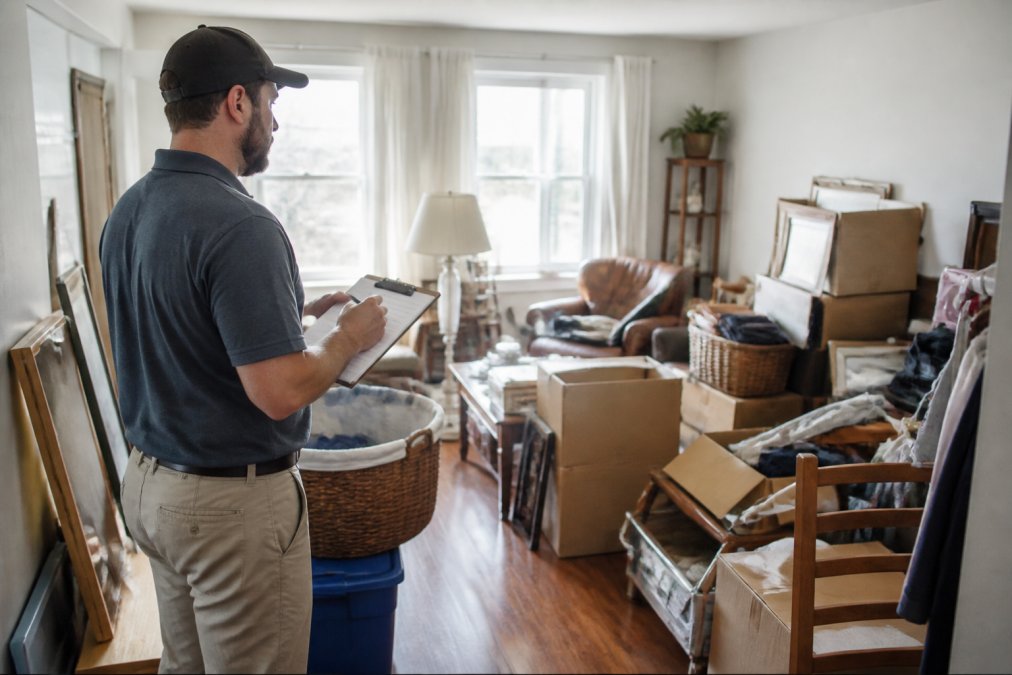
Pay special attention to the attic, basement, and garage, which often hold old electronics, paint cans, and yard equipment. Understanding the full scope, including items that require special handling, will make your conversations with a junk removal company more productive.
Create a Sorting Strategy: Keep, Donate, Sell, Discard
Once you know what you're dealing with, establish a sorting strategy using four distinct zones with different colored labels: Keep, Donate, Sell, and Discard. This system prevents you from making decisions twice and keeps the process moving efficiently.
Work through the home room by room, handling each item only once. Designate a specific area for keep items so they don't get mixed back into the discard piles. For donations, research local charities that offer pickup services. For items you want to sell, set them aside for an online marketplace or consignment shop, but be realistic about the time commitment.
A Room-by-Room Decision Framework
A generic sorting strategy often falls apart when you're overwhelmed by decades of accumulated possessions. Apply a specific decision framework to each space:
- Kitchen: Duplicates are the first to go. If you have three spatulas or two sets of everyday dinnerware, keep the best set and discard the rest. Appliances that haven't been used in the past year, bread makers, juicers, specialty pans, are prime candidates for donation. Check cabinets for expired canned goods and old spices, which should be discarded immediately.
- Bedrooms: Clothing is often the largest category. A practical rule is to keep items you've worn in the last 12 months, excluding seasonal wear. For closets, evaluate shoes and accessories with the same lens. Linens and towels with stains or tears should be discarded or repurposed as rags, not donated.
- Living and Dining Rooms: Books, media, and decorative items accumulate quickly. For books, keep only those you reference or plan to reread; the rest can be donated to libraries or used bookstores. Electronics like old DVD players or stereo systems are often obsolete; check with local e-waste recyclers for proper disposal.
- Attic, Basement, and Garage: These areas are catch-alls for the 'maybe' items. Be ruthless with half-empty paint cans, old chemicals, and broken tools. Holiday decorations should be consolidated into clearly labeled bins, and only kept if you actually use them each year.
Handling Sentimental Items and Personal Effects
Sorting through a lifetime of possessions can be emotionally draining, especially during an estate cleanout. If you are uncertain about an item, place it in a "maybe" box and revisit it at the end of the day when you have more perspective.
Take breaks and step away from the task. Photograph items you are letting go of to preserve the memory without keeping the physical object. For items with genuine monetary or historical value, such as antiques or jewelry, get an appraisal before you decide to donate or discard them.
Managing Important Documents and Digital Assets
Before the crew arrives, search for passports, birth certificates, property deeds, financial records, and tax returns. Set these aside in a secure folder immediately so they don't accidentally end up in a junk pile.
Old computers, phones, and external hard drives contain personal data that requires proper handling. Before disposing of any electronics, back up important files and perform a factory reset or use data destruction software to wipe the drive. Create a list of online accounts and passwords, as this is often the only record of a person's digital footprint during an estate cleanout.
The Financial Angle: Donation Receipts and Tax Deductions
When you donate items to a qualified nonprofit, the value of those goods may be deductible on your federal income tax return. To claim this deduction, you must itemize on Schedule A and obtain a written acknowledgment from the charity for any single donation valued at $250 or more. This receipt must include a description of the items, but not their value, that determination is your responsibility.
For valuation, the IRS expects 'fair market value,' which is what a willing buyer would pay a willing seller. For used clothing and household goods, this is typically a small fraction of the original purchase price, often 10% to 30% for items in good condition. The IRS publication 526 provides detailed guidance, and the Internal Revenue Service's guidance on charitable contribution valuation outlines the specific rules. For high-value items like art, jewelry, or antiques, a qualified appraisal is often required if the value exceeds $5,000. Keep all receipts and a list of donated items in your tax file; this documentation is your only defense in an audit.
Decide: Dumpster Rental vs. Full-Service Junk Removal Services
After assessing the scope, you need to decide between renting a dumpster and hiring full-service junk removal services. A dumpster rental makes sense for large renovation projects where you have the time and physical ability to haul items yourself. However, this option requires you to handle the heavy lifting, obtain any necessary permits, and manage the disposal timeline.
For most homeowners, especially those dealing with a whole house cleanout or an estate, a full-service crew is the more practical choice. A professional team handles all the heavy lifting, sorts items for recycling and donation, and ensures proper disposal. With same-day and next-day availability, you can schedule the service around your needs rather than waiting for a dumpster drop-off and pickup window.

| Option | Best For | Key Consideration |
|---|---|---|
| Dumpster Rental | DIY renovations, ongoing projects | You handle all labor and logistics |
| Full-Service Junk Removal | Estate cleanouts, whole house cleanouts | Crew does the heavy lifting and disposal |
Prepare Your Home and Gather Essential Safety Gear
Preparing your home before the crew arrives protects both your property and the workers. Clear a path from the main piles to the exit, moving any fragile items or tripping hazards out of the way. If you have stairs or narrow hallways, consider removing doors from their hinges to create more space for moving large furniture.
While the crew will bring their own equipment, gather essential safety gear for yourself if you plan to help with sorting. This includes heavy-duty work gloves, closed-toe shoes with good grip, and a dust mask to protect against mold and dust. Keep a first-aid kit accessible, and be cautious of sharp objects, nails, and broken glass.
What to Expect When Your Whole House Cleanout Crew Arrives
The crew will typically arrive within a scheduled window and begin by confirming the scope of the job with you. They will then start loading items, working from the largest pieces down to the smaller boxes and bags. A professional team will protect your floors and walls with pads and take care to avoid damage.
A full-service team will also sweep the cleared areas and ensure that no debris is left behind. The entire process for a whole house cleanout can take anywhere from a few hours for a single room to a full day for an entire property. You should expect to be present to answer questions and confirm which items are being removed, but you won't need to lift a finger.
Plan for Estate Cleanout Services: Donations, Hazardous Waste, and Taxes
Estate cleanout services often involve more complex considerations than a standard decluttering project. One of the most important is understanding the tax implications of your donations. If you donate items to a qualified nonprofit organization, you may be eligible for a tax deduction. To claim this, you must obtain a detailed receipt from the charity that lists the items donated and their estimated value. The Internal Revenue Service guidelines on charitable contributions provide the specific requirements for documentation and valuation.
Proper disposal of hazardous waste is another critical element of responsible cleanout. Items like paint, chemicals, batteries, and fluorescent bulbs cannot be thrown in a regular dumpster. Many municipalities offer specific drop-off locations for household hazardous waste, and your junk removal company should be knowledgeable about these regulations. As detailed in the Environmental Protection Agency's guide on household hazardous waste, improper disposal of these materials poses risks to both human health and the environment. A reputable company will ensure these items are diverted to the appropriate facilities, not a landfill.
The Digital Estate: A Modern Cleanout Essential
A home cleanout today is as much about digital assets as it is about physical possessions. Failing to address this can lead to identity theft and the permanent loss of irreplaceable digital memories. Before the crew arrives, you must account for the digital footprint left behind on every device.
Inventory all devices. This includes desktop computers, laptops, tablets, smartphones, external hard drives, USB flash drives, and even old routers or network-attached storage devices. Each one may contain personal data, financial records, or family photos.
Back up what matters. Before wiping any device, connect it to an external drive and copy over important documents, photos, and videos. Cloud storage services like Google Drive, iCloud, or Dropbox are also options, but be mindful of storage limits and subscription renewals.
Securely erase data. A simple 'delete' is not enough. For computers, use a data destruction tool that overwrites the drive multiple times, or remove the hard drive entirely and physically destroy it. For smartphones and tablets, perform a factory reset after backing up. This step is non-negotiable for protecting financial accounts and personal information.
Handle online accounts. Create a list of all known online accounts, email, banking, social media, utilities, subscriptions. For an estate cleanout, you may need to close accounts or transfer them to a family member. Major platforms like Google and Facebook offer legacy contact or inactive account manager features that allow a designated person to manage the account after death. Documenting these details is a gift to the executor of the estate.
The Post-Cleanout Deep Clean Checklist
A professional cleanout leaves the space empty, but it rarely leaves it clean. Dust, dirt, and debris that were hidden behind furniture and boxes are now exposed. Before you list a property for sale, move in new furniture, or hand over the keys, a deep clean is essential. Use this checklist to ensure the space is truly move-in ready:
- Dust and wipe all surfaces: Start from the top and work down. Ceiling fans, light fixtures, window sills, and baseboards accumulate a surprising amount of dust.
- Clean windows and tracks: Natural light makes an empty room look larger and more inviting. Clean the glass and the window tracks, which often hold years of grime.
- Scrub floors: Vacuum and then mop hard floors. For carpets, consider a professional steam cleaning to remove odors and stains left by heavy furniture.
- Wipe down cabinets and closets: Empty cabinets and closets should be wiped inside and out. This is also the time to check for pests or signs of moisture damage.
- Deodorize the space: Odors from pets, smoke, or mildew can linger. Air out the property for a few hours and use an odor eliminator on fabrics and carpets.
- Check for damage: With the space empty, you can finally see the condition of the walls and floors. Note any holes, scuffs, or water stains that need repair before a real estate walkthrough.
A thorough post-cleanout cleaning ensures you don't just remove the clutter, you reset the space entirely, making it ready for its next chapter.
Schedule Your Home Cleanout and Finalize Logistics
With your sorting complete and your plan in place, the final step is to schedule your home cleanout and finalize the logistics. Contact your chosen junk removal service to confirm the date and time, and ask about their specific process for arrival and payment. This is also the time to ask any clarifying questions about what items they can and cannot accept.
A reliable service will offer transparency about their schedule and pricing. Before the crew arrives, do a final walkthrough to ensure you haven't left any items you intended to keep, and confirm that all your important documents are secure. This preparation ensures a smooth, stress-free experience.
Conclusion
Preparing for a home cleanout service is a manageable project when you break it down into clear steps. By assessing the scope, creating a sorting strategy, and planning for logistics, you can transform an overwhelming task into an organized process.
When you're ready to clear out the clutter, a professional team makes all the difference. Mike's Top Junk Removal offers the transparent pricing and reliable scheduling that takes the stress out of the process. With free estimates, upfront pricing, and same-day or next-day availability, we handle the heavy lifting so you can focus on what matters most. Get your free estimate today and let us help you reclaim your space.
Frequently Asked Questions
How much do house cleanouts cost?
The cost of a home cleanout varies based on the volume of items and the level of service. A full-service crew that handles all the sorting, lifting, and disposal will cost more than a dumpster rental you load yourself. For a transparent price, request a free estimate. Mike's Top Junk Removal provides upfront pricing based on how much space your items take up in the truck, so you know the exact cost before any work begins.
Should I sort items before hiring professional junk haulers?
Yes, you should sort items before your junk removal appointment, even with a full-service crew. Separate items into clear categories: keep, donate, sell, and discard. This ensures nothing important gets thrown away and helps you direct donations to the right places. While the crew will handle all the heavy lifting and removal, having a sorting strategy in place makes the process faster and ensures you control what happens to your belongings.
How do I handle sensitive documents during a home cleanout?
Collect all sensitive documents like tax returns, bank statements, and legal papers before the crew arrives. Keep them in a secure box or bag separate from the discard pile. After the cleanout, decide what to keep and what to shred. For digital assets, back up any important files from old computers or hard drives before disposal. Never place documents with personal information in regular trash or recycling without shredding them first.
What items are typically excluded from professional junk removal services?
Most junk removal companies cannot haul hazardous materials such as paint, chemicals, asbestos, and certain cleaning products due to safety and environmental regulations. Items like tires and large appliances with refrigerants may also require special handling. Ask your provider about specific exclusions when you book. Mike's Top Junk Removal will guide you on how to properly handle items we cannot take.