

Table of Contents
- What the IRS Actually Requires Before You Claim a Deduction
- Written Acknowledgment Requirements: What a Valid Receipt Must Include
- Determining the Fair Market Value of Donated Goods
- Form 8283 Noncash Charitable Contributions: When You Must File It
- Recordkeeping for Tax Purposes: Building a System That Holds Up
-
Common Mistakes That Trigger Audits on Charitable Deductions
- 1. Round-Number Valuations With No Source
- 2. Missing Acknowledgments at the $250 Line
- 3. Claiming Items in Poor Condition
- 4. No Proof the Organization Qualifies
- 5. Mixing Personal and Donated Items in One Load
- 6. Skipping Form 8283 When Noncash Gifts Exceed $500
- 7. No Appraisal for High-Value Single Items
- 8. Inconsistent Dates Across Documents
- A Quick Pre-Filing Self-Audit
- How to Document Charitable Donations When You're Decluttering
- Frequently Asked Questions
Last Updated: September 25, 2026
What the IRS Actually Requires Before You Claim a Deduction
The IRS requires proof before it allows any charitable donation deduction. Documentation is the difference between a legitimate write-off and a disallowed claim.
Three things must line up:
- A qualified organization received the gift
- You kept a written record of what you gave
- You can support the value you claimed
Written Acknowledgment Requirements: What a Valid Receipt Must Include
A written acknowledgment must come from the charity and show four things: the organization's name, the date of your gift, a description of what you gave, and whether you received anything in return.
A valid receipt should include:
- The charity's legal name and tax-exempt status
- The contribution date
- A description of the donated items
- A statement of whether any goods or services were provided to you
- A good-faith estimate of the value of anything you got back
The $250 Threshold and What Changes Above It
Donations of $250 or more require a written acknowledgment from the charity before you file. A bank record alone will not satisfy the IRS at this level.
Determining the Fair Market Value of Donated Goods
The fair market value of donated goods is what a willing buyer would pay for the item in its current condition. It is not what you originally paid.
Use these sources to set a defensible value:
- Resale listings for similar items in similar condition
- Published valuation guides used by charities
- Photos showing the item's condition before pickup
Condition Rules and What the IRS Won't Accept
The IRS only allows deductions for items in good used condition or better. Torn, stained, or broken goods generally do not qualify.
What to avoid:
- Deducting items you would not give to a friend
- Claiming full retail value for worn goods
- Skipping photos that prove condition
Form 8283 Noncash Charitable Contributions: When You Must File It
You must file Form 8283 noncash charitable contributions when your total noncash gifts exceed $500 for the year. Cash gifts do not count toward this threshold.
Appraisal Requirements for High-Value Items
A qualified appraisal is required for any single donated item worth more than $5,000. The appraiser must meet IRS standards and sign the form.
Keep in mind:
- The appraisal must be done close to the donation date
- You need the appraiser's signature on Section B
- The charity must also sign the acknowledgment portion
Recordkeeping for Tax Purposes: Building a System That Holds Up
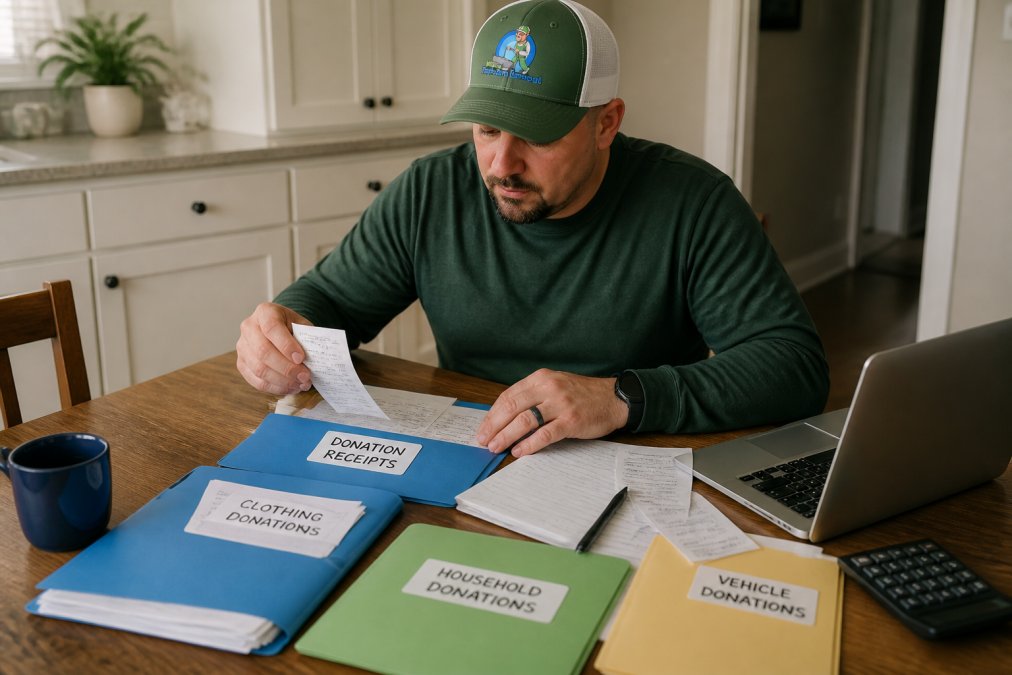
Most guides stop at "keep your receipts." That advice fails the moment an examiner asks you to produce a specific acknowledgment from three years ago in under five minutes. The gap on the SERP is digital record-keeping, a searchable, backed-up system that survives both an audit and a hard drive failure.
The Four-Layer File System
Build your records in four layers so any single document can be reconstructed even if one layer is lost:
- Source layer, the original acknowledgment letter, bank record, or appraisal, saved as a PDF the day you receive it.
- Index layer, a spreadsheet with one row per gift: date, organization name, EIN, gift type (cash or noncash), description, claimed value, and the file name of the supporting document.
- Visual layer, dated photos of noncash items, named to match the index row.
- Backup layer, a cloud folder synced to a local drive, so a lost phone or dead laptop does not erase your proof.
File Naming That Actually Works in an Audit
A folder full of files called "receipt1.pdf" is useless when you need to match a specific gift to a specific acknowledgment. Use a consistent convention:
YYYY-MM-DD_OrganizationName_GiftType_Amount
Example: 2026-03-14_LocalFoodBank_Noncash_450
What to Scan vs. What to Keep in Paper
- Scan: acknowledgment letters, bank records, credit card statements showing the gift, and photos.
- Keep in paper: signed appraisals for high-value items and any original signature page the charity provided, since a scanned signature can be challenged.
- Keep both: anything tied to a single item valued above the Form 8283 Section B threshold.
Retention: The Three-Year Rule and Its Exceptions
The general rule is to keep charitable donation records for at least three years after you file the return claiming the deduction, because that is the standard window for the IRS to assess additional tax. Two exceptions matter:
- If you underreport gross income by more than 25%, the window stretches to six years.
- If you file a claim for a refund, keep records for three years from the date you filed the claim or two years from the date you paid the tax, whichever is later.
A Quarterly 15-Minute Maintenance Routine
Set a recurring calendar reminder once a quarter. In that window:
- Reconcile the index spreadsheet against your bank and credit card statements.
- Confirm every gift of $250 or more has a written acknowledgment on file.
- Rename any files that broke the naming convention.
- Verify the cloud backup actually synced.
| Record Type | What It Proves | How Long to Keep It |
|---|---|---|
| Written acknowledgment | Gift amount and charity status | 3 years minimum |
| Photos of items | Condition and description | 3 years minimum |
| Appraisal | Value of high-dollar items | 3 years minimum |
| Bank records | Cash gift proof | 3 years minimum |
| Index spreadsheet | Cross-reference for every gift | 3 years minimum |
Common Mistakes That Trigger Audits on Charitable Deductions
Most audit problems come from sloppy records, not bad intentions. The Internal Revenue Service flags claims that lack substantiation, and the pattern is predictable: the deduction looks reasonable on the return, but the file behind it cannot answer a basic question.
Here is what actually draws scrutiny, and why.
1. Round-Number Valuations With No Source
A deduction of exactly $500 or $1,000 for a bag of household goods signals an estimate, not a valuation. Examiners look for a defensible method, comparable resale listings, a published valuation guide, or a documented condition assessment. If your number cannot be traced to a source, it can be reduced or disallowed.
2. Missing Acknowledgments at the $250 Line
This is the single most common failure. A canceled check proves you paid, but it does not prove whether you received goods or services in return. At $250 or more, only a written acknowledgment from the organization satisfies the requirement. Without it, the entire deduction for that gift can be denied, even if the gift was real and the charity confirms it verbally.
3. Claiming Items in Poor Condition
The deduction is limited to property in good used condition or better. A stained sofa or a non-working appliance generally does not qualify, and claiming it invites a condition challenge you cannot win without dated photos. The fix is simple: photograph items before they leave the house, and exclude anything you would not pass along to a friend.
4. No Proof the Organization Qualifies
Not every organization that accepts goods is a qualified charitable organization. Before you claim the deduction, confirm the organization's status using the IRS Tax Exempt Organization Search. Keep a screenshot or printout of the result with your records. If the organization is not qualified, no amount of receipts will save the deduction.
5. Mixing Personal and Donated Items in One Load
When a single pickup contains both donated goods and items you are simply discarding, the receipt becomes ambiguous. The organization can only acknowledge what it received. Separate the loads, or at minimum keep a written inventory that distinguishes donated items from discarded ones, so the acknowledgment matches what you actually gave.
6. Skipping Form 8283 When Noncash Gifts Exceed $500
If total noncash contributions exceed $500 for the year, Form 8283 must be completed and attached to your return. Failing to file it is a paperwork error that can disallow an otherwise valid deduction. For single items or groups valued above $5,000, Section B and a qualified appraisal are also required.
7. No Appraisal for High-Value Single Items
A qualified appraisal is required for any single donated item worth more than $5,000. The appraisal must meet IRS standards, be conducted close to the donation date, and include the appraiser's signature on Section B. A self-assigned value, no matter how well researched, does not substitute.
8. Inconsistent Dates Across Documents
When the acknowledgment date, the bank record date, and the photo date do not align, the file looks reconstructed rather than contemporaneous. Keep dates consistent by recording each gift on the day it happens.
A Quick Pre-Filing Self-Audit
Before you file, run these five checks:
- Every gift of $250 or more has a written acknowledgment on file.
- Every noncash item has a dated photo and a stated condition.
- Every valuation traces to a source you can name.
- Form 8283 is completed if noncash gifts exceed $500.
- Any single item above $5,000 has a qualified appraisal with the required signatures.
If all five pass, your file is in better shape than most. If any fail, fix it before you file, not after a notice arrives.
How to Document Charitable Donations When You're Decluttering
Decluttering creates the biggest documentation challenge. A whole-house cleanout can produce dozens of donated items in a single day.
For each donated load:
- List the items by category
- Note the condition of each
- Photograph the full load
- Get a receipt from the charity
Frequently Asked Questions
What documentation does the IRS require for charitable donations?
For cash donations under $250, a canceled check, bank statement, credit card statement, or written acknowledgment from the charity works. Donations of $250 or more require a contemporaneous written acknowledgment from the organization stating the amount, whether you received goods or services in return, and a description of anything received. Noncash donations over $500 require Form 8283. Keep all records for at least three years after filing.
How do I prove a non-cash donation for tax purposes?
Start with a written acknowledgment from the qualified organization listing the items donated and the date. For items valued over $500 total, file Form 8283 with your return. Take photos of items before donating and keep a detailed list noting the fair market value of donated goods, their condition, and how you arrived at that value. For single items worth more than $5,000, a qualified appraisal is required.
Can I deduct a donation to a charity on my taxes without itemizing?
Generally, you must itemize deductions on Schedule A to claim charitable contributions. The standard deduction is higher than most people's itemized total, so many filers do not itemize. If your total deductions including charitable giving exceed the standard deduction threshold, itemizing may benefit you. Consult a tax professional to determine whether itemizing makes sense for your situation.
Is a bank record sufficient for charitable donation deductions?
A bank record such as a canceled check or credit card statement showing the charity's name and the date and amount of the contribution is sufficient for cash donations under $250. For donations of $250 or more, you need a written acknowledgment from the charity in addition to the bank record. The acknowledgment must be obtained before you file your return.
Sorting donations from trash is the hardest part of any cleanout, and it is where most people lose track of their records. Mike's Top Junk Removal makes that split simple with free estimates, upfront pricing, and same-day or next-day availability. Our family-owned team handles everything from single-item pickups to full estate cleanouts, so you can focus on the receipts while we handle the haul. Get started with Mike's Top Junk Removal and reclaim your space without the stress.